
I want to tell you something nobody in the productivity space wants to admit.
I was working on four goals at the same time. A blog. A startup idea. A side project. A personal development plan. Every single day felt busy. Every single week, I looked at what I’d actually moved forward — and it was almost nothing.
The problem wasn’t effort. I had plenty of that. The problem was that I refused to quit anything.
That’s when I discovered the real importance of quitting — not quitting on your dreams, but quitting on the things that are quietly killing them.
Most people aren’t stuck because they quit too early. They’re stuck because they refuse to quit at all.
If you’ve ever felt busy but not productive, spread thin but not moving, then this article is for you. We’re going to talk about strategic quitting: what it is, why it matters, and how to use it to become genuinely more focused and productive.
Quitting has a branding problem
From the time we’re children, we’re handed the same script: don’t quit, keep going, winners never quit. It’s repeated so often that most of us never stop to question it.
But there’s a massive difference between quitting because something is hard — and quitting because something is wrong for where you’re going.
The first kind is avoidance. The second kind is strategy.
When Seth Godin wrote The Dip, his entire argument was built on this distinction. The most successful people in any field are not the ones who push through everything. They’re the ones who are brutally selective about what they push through.
That selectivity is what I mean by strategic quitting.
What strategic quitting actually means
Strategic quitting is not giving up. It’s not laziness. It’s not a lack of discipline.
It’s the deliberate decision to stop doing something that is consuming your time, energy, and attention — so that something more important can finally have all three.
Think about it this way. Imagine you have a glass of water. If you pour five different things into it at once, you get a diluted mess of everything. But if you pour your entire focus into one glass? That glass overflows.

That overflow is progress. That’s what strategic quitting creates space for.
Quitting becomes productive when it creates space for something better. That’s the only reason to quit — and it’s reason enough.
Why spreading yourself thin feels productive (but isn’t)
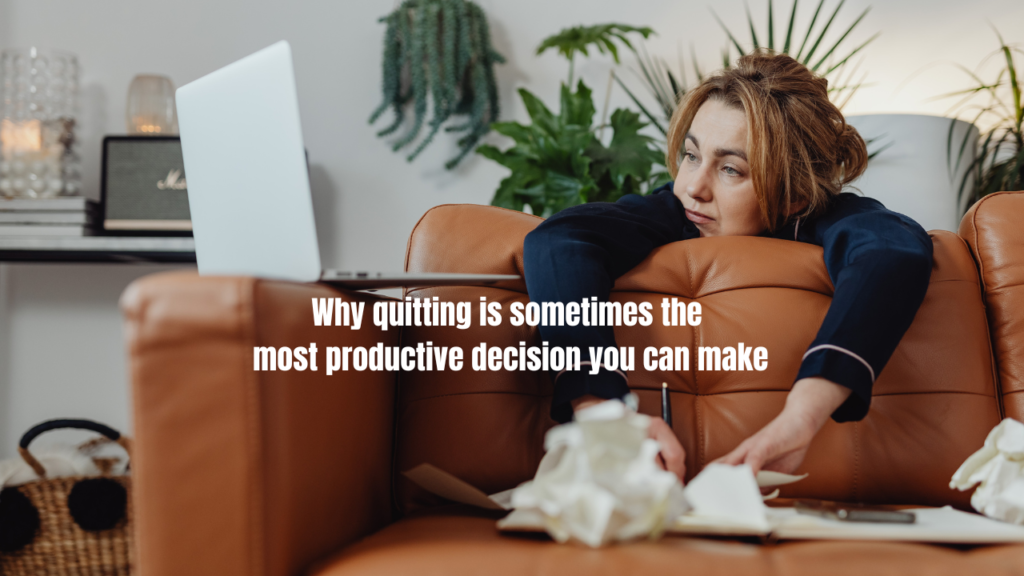
Here’s the trap. Working on multiple goals at once feels like momentum. Your calendar is full. You’re always doing something. You go to bed tired.
But tired isn’t the same as effective.
Every time you split your attention between two projects, neither one gets your best thinking. You’re present in one, mentally in the other. A study published in the American Psychological Association found that even “mild multitasking” can reduce productivity by as much as 40%. You’re not working twice as hard. You’re working at 60% of your potential on everything.
The irony of chasing multiple goals simultaneously is that you end up slower on all of them than if you had simply chosen one and gone deep.
The real cost of refusing to let go of goals
Let me be direct with you: letting go of goals is uncomfortable. Your brain resists it. You think, “What if this one is the idea that works?” or “I’ve already put so much time into this.”
That second one is the sunk cost fallacy. The time you’ve already spent is gone. The question is never about what you’ve invested. It’s always about what you want to earn going forward.
When you refuse to let go of a goal that no longer serves you, here’s what actually happens:
- Your primary goal suffers. Every minute your attention is elsewhere is a minute your main project doesn’t get.
- Decision fatigue compounds. The more open loops you carry, the more mental energy they consume — even when you’re not actively working on them.
- Your confidence erodes. Slow progress across five things feels like failure. Fast progress on one thing feels like momentum. Same effort. Completely different psychology.
- You never truly commit. The backup plan that’s always quietly running prevents you from going all-in on anything.
This is why understanding the importance of quitting is not a soft, feel-good idea. It’s a performance decision.
How to know when it’s time to quit something
Not everything deserves to be quit, of course. Some things are hard because they’re new. Some resistance is the friction of growth, not a signal to stop.
So how do you tell the difference?
Ask yourself these three questions before you make any decision to quit:
1. Is this moving me toward my highest-priority outcome?
Every goal you hold should be in service of something larger. If you can’t draw a clear line from this project to your most important goal — right now, this season — it’s a candidate for the quit list.
2. Does this still have real leverage?
Some projects had a window. That window may have closed. Others were learning experiments that taught you what you needed to know. The lesson was the point. There’s no shame in saying: I got what I came for. Now I can move on.
3. What am I sacrificing by continuing?
This is the most important question. We always ask what we’ll lose by quitting. We almost never ask what we’re losing by not quitting. The opportunity cost of staying is often far higher than the cost of leaving.
If you answer these three questions honestly, the decision usually becomes obvious. Most people already know what they need to let go of. They’re just waiting for permission. Consider this yours.
A framework for strategic quitting
Here’s a simple process I use — I call it the Clear Path Method:
- List everything. Write down every goal, project, or idea you’re actively working on or thinking about. Get it all out of your head and onto paper.
- Rank by impact. If you could only keep one, which would it be? Now rank all of them. Be ruthless. Your gut usually knows the order before your brain does.
- Apply the 1-2 rule. Focus on no more than two active priorities at any time. Everything else gets either quit entirely or moved to a “future list” that you don’t look at until one of your current priorities is complete.
- Quit cleanly. Don’t say “paused.” Don’t say “on hold.” If you say “paused,” part of your brain keeps the tab open. Close the tab. If it’s truly worth returning to, it will still be worth it in six months.
- Review quarterly. Every three months, revisit your focus. Circumstances change. What mattered in January may not matter in April. Quitting is not a one-time act. It’s a habit of editing your life as you grow.
What happens after you quit the right things
I want to tell you what happened after I let go of three of my four parallel projects.
In the first week, I felt guilty. Almost like I’d betrayed the ideas I’d been carrying around.
By the second week, something shifted. I sat down to work on my one remaining project and I had more energy for it than I’d had in months. I wasn’t mentally bouncing between tabs. I wasn’t managing the guilt of neglected projects. I was just — present.
Within 90 days, I had moved further on that one focus than I had on all four combined in the previous six months.
That’s what happens when you understand the real importance of quitting. You stop spreading water across a cracked floor and finally fill one container.
The three outcomes of strategic quitting
Every time you quit something deliberately, one of three things happens — and all three are good:
You succeed faster
Freed from the drag of low-priority work, your main focus accelerates. The energy, time, and creative attention that were divided become unified. What would have taken two years now takes one.
You discover it wasn’t the right thing anyway
Once you step back, you often realize the thing you were holding onto was held by fear, not love. Fear of wasting the time you’d invested. Fear of what it would mean about you to let it go. When you release it, there’s often relief — not loss.
You come back to it stronger
If the quit idea was truly worth pursuing, it will still be worth pursuing once your primary focus succeeds. And when you return, you’ll return with more resources, more experience, and more clarity about how to do it right.
The bottom line
If you want to know how to be more productive, this is the answer nobody wants to give you: do less, better.
Not because you’re not capable of doing more. But because real progress requires depth, not breadth. It requires betting on yourself — really betting, not hedging with five backup plans running in the background.
Strategic quitting isn’t weakness. It’s the discipline to say: this is my one thing, and everything else can wait.
Letting go of goals that no longer serve you is not giving up on your future. It’s the single most decisive act of commitment to it.
So here’s my question for you: what’s the one thing you’re holding onto right now that, if you’re honest, you already know you need to quit?
Leave a comment below. Sometimes saying it out loud is the first step.