
Over the past decade, your digital identity has quietly become one of the most valuable things you own — more powerful than your passport, more visible than your résumé, and more permanent than most real-world conversations you will ever have.
Every account you create, every platform you log into, every purchase you make online is building a fingerprint that represents you to the world. Right now, that fingerprint is scattered across hundreds of different apps, databases, and servers. According to a 2023 report by Digital Shadows, the average person has over 300 online accounts. Most of those accounts, you no longer remember exist.
That matters — because in 2023 alone, over 8 billion records were exposed in data breaches worldwide. Not stolen from hackers in hoodies. Stolen from the companies you handed your data to when you clicked “I agree.”
Something fundamental is about to change.
We are entering the era of what technologists are calling Digital Identity 2.0: a structural shift in how your online identity is created, managed, stored, and protected. Over the next three to five years, this shift will reshape everything from how you log into apps, to how you prove who you are, to how AI systems represent you online.
But here is what the mainstream coverage keeps missing: this is not primarily a security story. It is a power story. The question is not whether your identity gets redesigned — it will. The question is who ends up holding the keys.
What Is Digital Identity 2.0?
To understand where we are going, it helps to see where we are right now — and be honest about how broken it is.
Your current digital identity is fragmented by design. You have a Google account, a LinkedIn profile, an Apple ID, a bank login, a healthcare portal, an Amazon account — and dozens more. Each holds a different piece of information about you. Each has its own password, its own privacy policy, and its own vulnerability to attack. When any one of those companies suffers a breach — and they do, regularly — your data is exposed because you had no choice but to hand it over in the first place. You cannot take it back. You cannot control where it goes next.
Digital Identity 2.0 flips this model entirely. Instead of your identity living inside dozens of company-controlled databases, it travels with you — portable, verifiable, and under your control.
It is built on five core principles:
- Unified but private — One identity layer that works across platforms, without exposing data you did not choose to share.
- Device-independent — Your identity is not locked to your phone or laptop. It follows you across devices and platforms through a secure cryptographic key.
- Verified but minimal — You can prove you are a real, trustworthy person without handing over your name, address, or date of birth. Just the proof, nothing more. (This is called a zero-knowledge proof, and it already works.)
- AI-enhanced — Artificial intelligence will actively manage, protect, and represent your identity across platforms.
- Secure by design — Passwords will largely disappear, replaced by passkeys, biometrics, and blockchain-backed credentials that cannot be stolen through phishing.
In short: the shift is from accounts you create on other people’s servers to an identity you own and carry.
Common Questions About Digital Identity 2.0
Before going further, it is worth addressing the questions most people ask when they first encounter this topic — because the answers clarify exactly what is at stake.
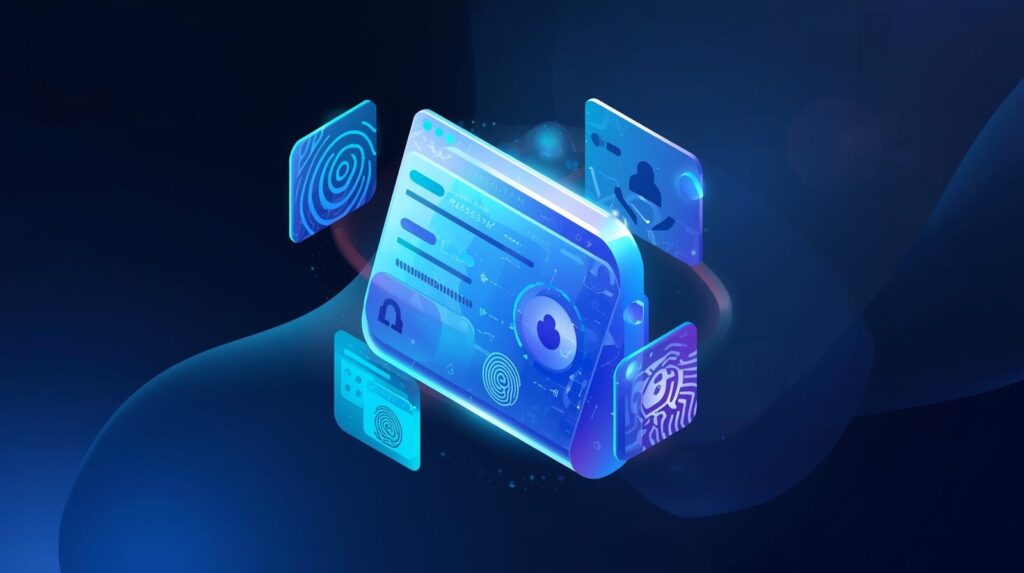
What is the difference between digital identity 1.0 and 2.0? Digital Identity 1.0 is what we use today — separate accounts on different platforms, each holding a piece of your personal information, controlled by those companies. Digital Identity 2.0 shifts the control to you. Your identity becomes portable, unified, and verifiable without sharing your raw personal data with every service you use.
Will passwords disappear completely? Not overnight — but the trend is unambiguous. Passkeys, biometrics, and cryptographic credentials are steadily replacing passwords for security-critical applications. The FIDO Alliance — backed by Apple, Google, and Microsoft — is explicitly working to make the password obsolete. Within five to seven years, entering a text password for a major service will likely feel as dated as signing a physical cheque.
What is a decentralised identifier (DID)? A DID is a unique identifier that you control, rather than one that a company or government assigns you. It is stored on a blockchain or distributed ledger, meaning no single organisation can revoke or manipulate it without your authorisation. The W3C published the DID specification as an open standard in 2022, and it now underpins many Digital Identity 2.0 implementations.
Is a unified digital identity safe? The security depends entirely on the architecture and governance around it. Well-designed systems — using decentralised identifiers and zero-knowledge proofs — can be significantly more secure than today’s fragmented approach. The risk is not the technology itself. It is how governments and corporations choose to implement and regulate it. Which brings us to the part that matters most.
This Is Already Happening — Here Are the Real Examples
This is not science fiction. The building blocks of Digital Identity 2.0 are already being deployed, and several of them you may already be using without realising it.
Apple and Google Passkeys
Since 2022, Apple has been rolling out passkeys — a technology developed by the FIDO Alliance that replaces traditional passwords entirely. Instead of a password, your device generates a unique cryptographic key that proves it is really you. No password to remember. No password to steal. Google, Microsoft, and over 13,000 websites now support the same standard, including PayPal, eBay, and GitHub. This is live, and it is the foundation of how Digital Identity 2.0 will authenticate people.
The EU Digital Identity Wallet
The European Union’s eIDAS 2.0 regulation requires all EU member states to offer citizens a Digital Identity Wallet by 2026. This wallet will let Europeans prove their identity, share verified credentials — a driver’s licence, a university degree, a medical record — and access government and private services, all without sharing more data than the transaction requires. It is the first major government-mandated implementation of self-sovereign identity, and it will cover over 450 million people. Other countries will follow.
Microsoft Entra Verified ID
Microsoft Entra Verified ID is already being used by enterprises to issue and verify digital credentials for employees, partners, and customers — using a decentralised identity model built on open W3C standards. Corporations are quietly building this infrastructure right now. Most employees will not notice until it replaces their ID badge.
World ID by Tools for Humanity
World ID, created by Sam Altman’s Tools for Humanity, takes a more radical approach: scanning your iris to generate a unique, private proof that you are a human being — not a bot. It is controversial, and the privacy concerns are real. But it points directly at one of the central problems Digital Identity 2.0 is trying to solve: how do you prove you are real in a world where AI can generate millions of convincing fake identities at near-zero cost? According to Meta’s own estimates, fake accounts represent approximately 5% of its monthly active users — roughly 150 million accounts. That problem only gets harder as generative AI matures.
AI Is About to Manage Your Digital Identity
Right now, you manage your digital identity manually. You create profiles, write bios, update information, reset passwords, and deal with breaches yourself. It is time-consuming, inconsistent, and often insecure — because humans make mistakes, and we are not wired to manage 300 accounts simultaneously.
In the next three years, AI will begin taking over these tasks on your behalf.
Several companies are already testing personal AI models trained on your data — your writing style, your communication preferences, your decision-making patterns. These models will act as an intelligent layer between you and the digital world. Think of it less like a chatbot and more like a chief of staff for your online life.
Practically, this means your AI agent will fill out forms on your behalf, sharing only what is strictly necessary. It will monitor your digital footprint for data leaks and alert you the moment something is exposed. It will generate temporary, disposable digital identities for risky platforms, so your real identity stays protected. It will handle routine digital interactions — booking, verifying, authorising — without your direct involvement.
This is also where the deeper shift in our relationship with technology shows up — the same pattern I explored in my piece on how smart home gadgets are quietly reshaping our behaviour: convenience arrives first. The deeper implications arrive later. With Digital Identity 2.0, the convenience is real. But the question of who your AI agent ultimately answers to — you, the platform, or the government — is one that most people are not yet asking.
Your Digital Identity Will Follow You Into the Physical World
The boundary between your online identity and your physical life is already dissolving. Within three years, it will largely be gone.
Your digital identity is becoming the key to your physical world. Consider what is already emerging:
- Smart home access — your verified identity replaces physical keys
- Workplace entry — biometric credentials replace ID cards
- Healthcare — your verified medical identity travels with you across hospitals and clinics
- Travel — digital travel documents replace physical passports at border control (already piloted in Australia, the UK, and the UAE)
- Payments — your identity and your payment method merge into a single verified credential
- Events and venues — your digital identity becomes your ticket, your membership, and your age verification simultaneously
Your phone will likely be your primary identity hub for the next decade. As wearable technology matures, it may extend further. The central idea is that your verified digital identity becomes as universally accepted as a government-issued ID — but far more capable, more granular, and harder to forge.
The Risks You Cannot Afford to Ignore
Every technological leap creates new vulnerabilities, and Digital Identity 2.0 is no exception. The risks here are not theoretical. They are being built into the architecture right now, while most of the public is not watching.
AI Impersonation and Deepfakes
As AI becomes better at mimicking your writing style, voice, and face, identity fraud escalates in a qualitatively different way. A stolen digital identity in 2028 will not just mean someone accessing your email — it could mean someone deploying an AI agent that convincingly poses as you in professional, legal, or financial contexts. The FBI reported that deepfake-related fraud losses exceeded $25 million in a single reported case in 2024. The verification systems being built now must stay ahead of this threat — and currently, many do not.
The Single Point of Failure Problem
Consolidating your identity into one portable credential is powerful. It also means that if that credential is compromised, the damage is catastrophic and total. There is no “change your password” recovery path when your credential is your identity. The security architecture behind Digital Identity 2.0 must be genuinely bulletproof in a way that no current system is. That is a demanding bar, and the history of technology suggests we will not clear it on the first attempt.
Reputation Scoring and the Invisible Gatekeeping
This is the risk that receives the least coverage, and it is arguably the most consequential.
As your digital identity becomes richer and more unified, it will inevitably become the basis for new forms of scoring. Insurance risk profiles. Employment screening. Credit decisions. Access to services. Rental applications. The technology that enables personalisation also enables discrimination at industrial scale — and unlike a human decision, an algorithmic one leaves no paper trail, faces no bias training, and generates no visible accountability.
China’s social credit experiments are not the only model to worry about. Western insurers, landlords, and employers are already using proxy data — social media activity, purchasing patterns, residential location — to make decisions about people. A unified digital identity does not create this problem. It supercharges it by giving every algorithm a far more complete and accurate dataset to work with. Who controls that data, under what rules, and with what right of appeal will be one of the defining political debates of the next decade.
State Control and the Surveillance Coin Flip
A unified digital identity is enormously useful for governments. The same infrastructure that lets you prove your age at a pharmacy can, in the wrong hands, let authorities monitor your movements, purchases, and associations in real time and at a level of granularity never before possible.
This is not a hypothetical. In 2022, Canada briefly invoked emergency powers to freeze the bank accounts of protest participants, identified partly through digital financial records. That was done with today’s fragmented infrastructure. Imagine the same capability applied to a unified credential system without robust legal safeguards.
The difference between a tool for citizen empowerment and a tool for state surveillance is not the technology. It is the governance around it. And governance is decided by whoever shows up to the debate.
The Narrative You Are Being Sold — and the One You Should Be Thinking About
Here is what most coverage of Digital Identity 2.0 gets wrong: it frames this as a security upgrade. Better passwords. Fewer breaches. Easier logins.
That framing is not false. But it is incomplete in a way that matters.
What is actually being built is the most comprehensive identity infrastructure in human history — a system capable of verifying, tracking, and representing every human being across every digital and physical context simultaneously. That system can be designed to serve the individual. Or it can be designed to serve whoever is in a position to demand access to its data.
The technology is identical in both cases. The difference is governance, and governance is not a technical problem. It is a political one.
Most of the people who will be most affected by this shift are not in the rooms where the standards are being written, the regulations are being drafted, or the architectures are being decided. That is the most important thing to understand about the moment we are in — not the technology itself, but who is shaping the context around it.
Navigating this kind of uncomfortable, high-stakes change — the kind where the rules are being written as you go — requires the same thing it always has: clear thinking, early positioning, and a refusal to treat passivity as a neutral choice. I explored exactly that dynamic in my piece on strategic decision-making under uncertainty.
How to Prepare Your Digital Identity Right Now
You do not need to wait for 2027 to start adapting. These five steps are available to you today.
1. Switch to passkeys wherever available. Both Apple and Google support passkeys natively. Enable them on every service that offers them. It is the single most impactful security upgrade available to most people right now — and it takes about sixty seconds per account.
2. Audit your data footprint. Use tools like Have I Been Pwned to check whether your email addresses appear in known data breaches. Then delete accounts you no longer use. Every dormant account is an exposure point you are not monitoring.
3. Use a password manager as a bridge. Until passkeys are universal, a good password manager — 1Password and Bitwarden are both excellent — keeps your existing accounts secure and makes the transition to passkeys smoother. If you are using the same password across multiple sites, you are already exposed.
4. Think before you share. Before creating a new account, ask whether you actually need to provide the data being requested. The less you share today, the smaller your exposure when the next breach happens. “Required fields” are often a policy choice, not a technical necessity.
5. Stay informed about your country’s digital identity plans. Whether it is the EU wallet, a national digital ID scheme, or a new government framework, these policies will affect your rights and your choices. The window for meaningful public input on how these systems get designed is open right now — and it will not stay open indefinitely.
The Bottom Line
Digital Identity 2.0 is not a distant possibility. It is being built right now by the largest technology companies, governments, and standards bodies in the world. The question is not whether it will reshape your online life. It will. The question is whether you will understand it well enough to navigate it on your own terms — and whether enough people engage with the governance questions before the architecture is locked in.
The technology, at its best, promises something genuinely valuable: an identity you actually own, that works everywhere, that cannot easily be stolen, and that does not require handing your personal information to every app that asks for it. That is worth being optimistic about.
But the most powerful systems in history have always been dual-use. A key that opens every door is enormously useful — and it matters enormously who has a copy.
You are one of the people who now understands what is at stake. That is not a small thing.
If this raised questions you want to explore further, drop them in the comments — I read every one. And if you want to think more clearly about the technology reshaping your life before it reshapes you, my newsletter covers exactly this territory. You can subscribe below.
You might also enjoy: Smart Homes: 7 Signs Gadgets Are Making Us Lazy | How to Overcome Resistance for Good | Strategic Quitting: Why Letting Go Is the Most Productive Decision